
Why You Keep Repeating Patterns You Thought You'd Changed
Recognizing a pattern and understanding what drives it are two different things.

You recognize the pattern. Maybe you keep putting off the same important work, even though you know the consequences. Maybe you find yourself having the same argument in different relationships. Or perhaps you repeatedly say yes to things you don't want to do, then wonder why you feel overwhelmed.
You've thought about it before. You've promised yourself you'll handle things differently next time. You might even understand, intellectually, why you do it.
And yet, somehow, you end up in the same place.
Why do we keep repeating patterns we genuinely want to change?
The answer isn't necessarily a lack of discipline or self-awareness. Sometimes, the challenge is that recognizing a pattern and understanding what drives it are two different things. And even when we understand the reasons behind our behavior, changing it requires more than simply deciding to do better.
The good news is that recurring patterns can become easier to recognize and work with. The first step is learning to look at them with enough curiosity to see what's actually happening.
What Are Behavioral Patterns, and Why Do They Repeat?
A behavioral pattern is a familiar way of responding to a situation. It might be something you do, something you think, or the way you react emotionally when a particular situation arises.
Some patterns are useful. You might have developed a reliable routine for managing a busy day or learned to stay calm when a project becomes complicated.
Other patterns can work against you.
You might avoid difficult conversations, seek approval before making decisions, become defensive when receiving feedback, or abandon a goal when progress gets uncomfortable.
These behaviors often persist because they serve some purpose in the moment, even when they create problems later.
Consider procrastination. Putting off a difficult task may temporarily relieve the discomfort of not knowing where to start. That immediate relief can make avoidance more likely the next time a similar task appears, even if delaying the work creates more stress in the long run.
Or consider always saying yes. Agreeing to help someone might preserve a sense of connection or prevent an uncomfortable conversation. The immediate benefit can outweigh a consequence that feels distant: having too much on your plate.
In both cases, the behavior makes a certain kind of sense when you look at the immediate situation.
A pattern can be counterproductive overall while still feeling useful in the moment.
Understanding that distinction changes the question. Instead of asking, "Why do I keep doing this when I know better?" you can start asking, "What does this behavior do for me in the moment, and what does it cost me afterward?"
That question is often more revealing.
5 Reasons You Keep Repeating the Same Patterns
There isn't one explanation for every recurring behavior. Different patterns have different causes, and the same behavior can serve different purposes for different people. These five possibilities are useful places to start investigating.
1. The pattern provides short-term relief
Some behaviors persist because they help you escape an uncomfortable feeling, at least temporarily.
You avoid a conversation because conflict feels unpleasant. You scroll through your phone because a demanding task feels overwhelming. You seek reassurance because uncertainty is difficult to sit with.
The behavior may reduce discomfort now, making it easier to repeat later.
The important question isn't just what you did. It's what you were feeling immediately before you did it.
Try asking yourself:
- What was I trying not to feel?
- What became easier when I responded this way?
- What did I gain in the short term, and what did I lose in the long term?
These questions help shift the focus from criticizing your behavior to understanding its function.
2. You react to assumptions you haven't examined
We don't respond only to what happens. We also respond to what we think an event means.
A colleague questions your idea, and you interpret it as a sign that they don't respect you. A friend takes longer than usual to reply, and you assume something is wrong. Your manager gives you constructive feedback, and you hear it as evidence that you're not good enough.
The interpretation can shape your reaction before you've had time to consider other explanations.
Over time, these interpretations can become familiar enough that they feel like facts.
One way to investigate this is to separate three things: what actually happened, the meaning you assigned to it, and how you responded.
For example:
- What happened: My colleague challenged my proposal.
- My interpretation: They don't trust my judgment.
- My response: I became defensive and stopped listening.
The interpretation might be accurate, partly accurate, or mistaken. The point isn't to force yourself to think positively. It's to recognize that an interpretation is something you can examine rather than something you must automatically accept.
3. The pattern is connected to how you see yourself
Some recurring behaviors are reinforced by the stories we tell ourselves about who we are.
"I'm not good at confrontation."
"I'm the person everyone relies on."
"I always lose interest before I finish."
"I'm just not someone who asks for help."
These statements can begin as descriptions of past experiences. But when you treat them as fixed truths, they can also influence what you do next.
If you believe you're bad at difficult conversations, you might avoid them. That avoidance leaves you with fewer opportunities to discover that you can handle them more effectively than you expected.
The pattern then appears to confirm the original belief.
To investigate this, ask yourself: Am I describing something I sometimes do, or defining something I believe I am?
That distinction can create room for a different response. You don't have to deny your past experiences to recognize that they don't dictate every future choice.
4. You recognize the behavior but miss the trigger
You might know that you become impatient, withdraw from conflict, or take on too much. But knowing the behavior exists doesn't necessarily tell you when it is most likely to occur.
Patterns often become clearer when you examine the situations surrounding them.
Perhaps you become impatient when you're tired and under time pressure. Maybe you avoid giving feedback when you worry about disappointing someone. Perhaps you overcommit when you're trying to prove your value at work.
If you only reflect on the outcome, these situations can seem unrelated. Looking at several examples side by side may reveal a common trigger.
Instead of asking only, "What pattern do I have?" try asking, "Under what circumstances does this pattern show up most often?"
The answer can help you identify the moments when a different response might be possible.
5. You expect insight to produce change automatically
Understanding why you behave a certain way can feel like a breakthrough. Sometimes it is. But insight doesn't automatically create a new habit.
You might recognize that you avoid difficult tasks because you're worried about getting them wrong. That understanding matters, but the next time a difficult task appears, the same discomfort may still be there.
Change often requires experimenting with a different response, observing what happens, and adjusting over time.
Rather than trying to eliminate a pattern all at once, identify one small behavior you can practice.
If you tend to avoid difficult tasks, you might work on the first ten minutes rather than demanding a perfect result. If you habitually say yes too quickly, you might practice saying, "Let me check my schedule and get back to you."
The goal isn't to become a different person overnight. It's to create opportunities to respond differently in situations where you usually follow the same script.
How to Examine a Repeating Pattern: A Practical Exercise
If you want to understand a recurring pattern in your own life, try working through the following exercise. Choose one specific behavior rather than attempting to analyze your entire life at once.
Step 1: Describe what happened
Choose a recent example.
Avoid broad statements such as "I always sabotage myself." Describe a specific situation instead.
For example: "I delayed starting a presentation until the day before it was due, even though I had time earlier in the week."
Specific examples are easier to examine than sweeping judgments about your character.
Step 2: Identify what happened just before
Think about the moments leading up to the behavior.
What was happening? What were you thinking about? What emotions did you notice? Were you tired, under pressure, uncertain, frustrated, or concerned about someone else's reaction?
You don't need to find a single definitive cause. Start by identifying what might have contributed.
Step 3: Look for the immediate payoff
Ask what the behavior accomplished in the moment.
Did it help you avoid discomfort? Preserve approval? Feel more in control? Delay a decision you weren't ready to make?
Then consider the longer-term cost.
This comparison can reveal why a behavior persists even when it doesn't serve your broader goals.
Step 4: Look for the pattern across multiple examples
Repeat the exercise with two or three other situations.
Look for similarities. Do the same emotions, assumptions, relationships, or circumstances appear repeatedly?
Be careful not to force a conclusion. Sometimes examples reveal a common thread; other times, behaviors that look similar on the surface have different explanations.
The objective is to develop a more accurate understanding of your own experience.
Step 5: Choose one different response to test
Once you have a working hypothesis, identify a small experiment.
If you suspect you become defensive when you feel misunderstood, try asking one clarifying question before responding.
If you tend to overcommit, pause before agreeing to a new request.
If you avoid starting because you're afraid of doing something badly, deliberately begin with an imperfect first draft.
Treat the experiment as information gathering, not a pass-or-fail test. Notice what feels difficult, what helps, and what you learn.
Step 6: Reflect on what happened
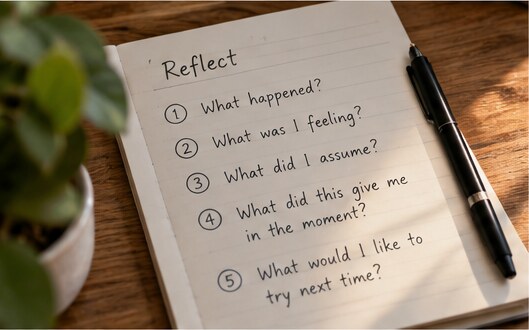
Afterward, ask yourself:
- What did I notice that I hadn't noticed before?
- What was easier or harder than I expected?
- Did my original explanation still make sense?
- What would I like to try next time?
This final step matters because it connects reflection to action. You aren't just analyzing your past; you're using what you learn to inform your next decision.
- Notice what happens
- Understand what drives it
- Try a different response
- Reflect and keep learning
Why Journaling Can Help You Recognize Recurring Patterns
It's difficult to recognize patterns when you're relying entirely on memory.
We tend to remember particularly emotional events, but we may overlook the smaller details surrounding them. We might recall that a meeting went badly without remembering the assumptions we made beforehand. Or we might remember feeling overwhelmed without noticing that we had agreed to several unnecessary commitments earlier in the week.
Journaling gives you a place to capture those details while they're still fresh.
Over time, your entries can become a record of how you respond to different situations. Looking back may help you notice recurring triggers, familiar interpretations, and behaviors that you hadn't connected before.
The value isn't simply in writing more. It's in asking questions that move beyond describing what happened.
Instead of writing only, "I had a frustrating day at work," you might explore:
- What specifically frustrated me?
- What did I expect to happen?
- What did I assume when things went differently?
- How did I respond, and what would I like to do differently next time?
These questions turn journaling into a form of active reflection.
A useful journal doesn't have to tell you what your patterns mean. It can help you examine the evidence, consider alternative explanations, and decide what you want to explore further.
And you don't have to reach a profound conclusion every time you write. Sometimes the most useful observation is simply noticing that a familiar reaction appeared again, under circumstances you hadn't previously recognized.
When a Thinking Partner Can Help
Writing on your own can be valuable, but it also has limitations. Sometimes you get stuck in the same explanation, repeat the same thoughts, or aren't sure what question to ask next.
A thoughtful follow-up question can help you look at an experience from another angle.
For example, if you write that you agreed to take on extra work even though you were already overwhelmed, a useful next question might be: "What were you worried would happen if you said no?"
Your answer might lead somewhere unexpected. Perhaps you wanted to be helpful. Perhaps you were concerned about how your manager would perceive you. Or perhaps you hadn't stopped to consider whether the request was actually a priority.
The point isn't for someone else to tell you who you are. It's to help you examine your own thinking more carefully.
That's the idea behind A Cool Journal.
A Cool Journal is an AI journaling app designed to act as a thinking partner, not just a place to store your thoughts. It uses follow-up questions to help you explore what you're experiencing, reflect on recurring themes, and connect what you learn to your goals and next steps.
You can start with what happened today and follow the questions wherever they lead. Over time, the aim is to make reflection more useful by helping you move from describing an experience to examining it and deciding what to do with what you discover.
You can learn more at acooljournal.com.
You Don't Have to Keep Repeating the Same Story
When a familiar pattern returns, it's tempting to treat it as proof that you haven't changed.
But a recurring behavior isn't a complete description of who you are. It's something to investigate.

You may discover that a habit serves a purpose you hadn't recognized. You may notice an assumption that shapes your reactions. Or you may find that you understand the pattern quite well but need to practice a different response.
Each possibility calls for a different approach, which is why curiosity is more useful than self-criticism.
Start with one recurring situation. Look closely at what happened, what you felt, what you assumed, and how you responded. Notice what the behavior gave you in the moment and what it cost you later. Then try one small alternative and reflect on the result.
You might not change the pattern immediately. But each time you examine it more carefully, you give yourself another opportunity to understand it.
The goal isn't to judge yourself for repeating the pattern. It's to understand it well enough to make a different choice next time.
Not just a journal, a thinking partner.
Free to download. Requires iPhone.


Founder of A Cool Journal. Writes about reflection, personality, and building a coach that asks better questions than it answers.
All posts by Erik Melander →